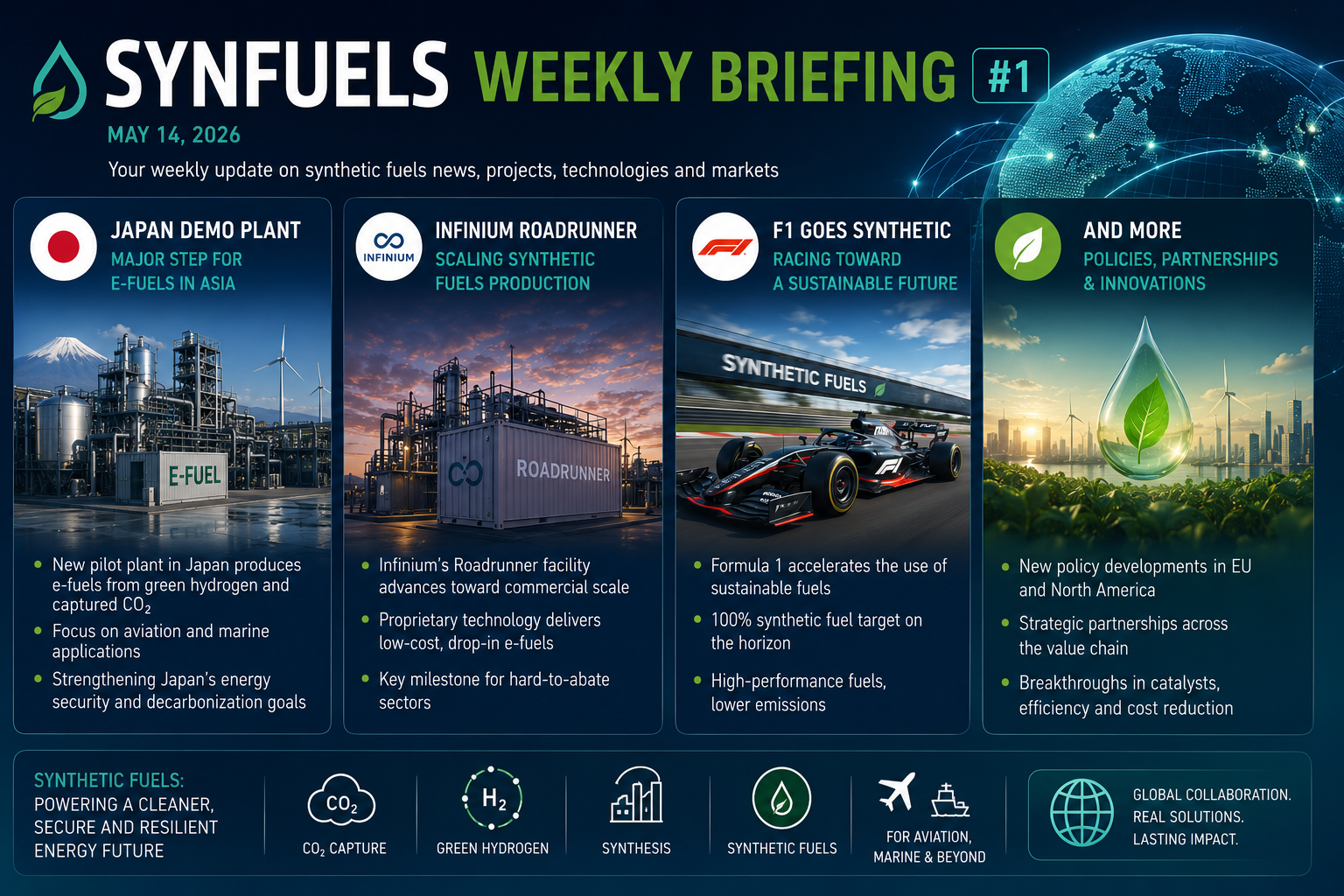

Synfuels Weekly Briefing #1
May 14, 2026
Japan demo plant · Infinium Roadrunner · F1 goes synthetic · Lorraine H₂ confirmed · SAF market update
Welcome to Synfuels Weekly Briefing — your professional weekly digest on synthetic fuels, e-fuels and SAF. Every week, we track the moves that matter: new projects, regulatory shifts, technology breakthroughs and market data. Issue #1 covers Japan’s first integrated synthetic fuel demonstration plant, Infinium’s Texas Roadrunner construction, Formula 1’s synthetic fuel transition, the Lorraine white hydrogen confirmation and the latest SAF market figures.
- 01Japan launches first fully integrated synthetic fuel demo plant
- 02Infinium breaks ground on Roadrunner — large-scale eFuels Texas
- 03Formula 1 confirms 100% synthetic fuel for 2026 season
- 04Lorraine white hydrogen: REGALOR II confirms massive deposit
- 05SAF: only 0.3% of global jet fuel in 2024 — but mandates accelerate

Japan has taken a significant step toward carbon neutrality in transport with the launch of a synthetic fuels demonstration plant — the first in Japan capable of carrying out the entire production process in one integrated system, from raw material supply to final fuel output.
Supported by the Japanese government under the Green Innovation Fund managed by NEDO (New Energy and Industrial Technology Development Organization), the plant officially began operations in September 2024 and is now running continuously.
The team uses the reverse water gas shift reaction to convert CO₂ and H₂ into synthetic gas, then Fischer-Tropsch synthesis to produce the final fuel. Researchers are now running the plant continuously to study production performance and identify technical issues before commercial scale-up.
The significance: Japan’s entry into integrated synthetic fuel production confirms the technology is spreading beyond Europe and the US — creating a genuinely global race for commercial-scale PtL e-fuels.

Infinium announced the construction of Project Roadrunner in May 2025 — a large-scale eFuels facility in Texas designed to convert captured CO₂ and renewable electricity into sustainable aviation fuel (SAF) and other synthetic fuels for domestic and export markets.
Infinium sits alongside HIF Global’s Texas Roadrunner project as part of a cluster of commercial PtL facilities emerging in Texas — benefiting from the US Inflation Reduction Act’s production tax credits of up to $3/gallon for SAF, which have triggered $100B+ in US e-fuel investment commitments.
The US is now competing directly with Europe on PtL commercial deployment — a development the EU was not anticipating as recently as 2022.

Formula 1 has committed to switching to synthetic fuels for the 2026 season — making it the world’s highest-profile and most demanding test bed for drop-in synthetic fuel technology. The World Rally Championship has already switched to synthetic fuels using P1 Performance-fuels products.
The FIA (Fédération Internationale de l’Automobile) plans for a 100% sustainable “drop-in” fuel capable of being used in current engines without modification. This is exactly the drop-in compatibility that makes e-fuels commercially powerful — no new infrastructure, no engine modification, instant compatibility with the existing fleet.
Both Bosch and Porsche acknowledge that synthetic fuels are not a silver bullet — EVs remain critical for personal urban mobility — but for high-performance, long-range and aviation applications, there is no electric alternative.
The most strategically significant story of 2026 for e-fuel economics is developing quietly in the Moselle region of northeastern France. The REGALOR II project, led by Française de l’Énergie (FDE) in partnership with CNRS researchers, is drilling toward 4,000 metres depth at Pontpierre — searching for the world’s largest known natural hydrogen deposit.
In January 2026, the French Official Journal granted FDE the “Trois Évêchés” exploration permit covering 2,254 km² of the Lorraine subsoil. The deposit, located at Folschviller in Moselle, was initially estimated at 46 million tonnes of natural hydrogen — a figure that, if confirmed, would dwarf any known deposit on Earth.
The drilling platform reached 2,600 metres in the first week of operations (January 2026), with the target of 4,000 metres set for February 2026. As of March 2026, FranceTransactions.com confirmed: “A drilling has confirmed the presence of massive natural hydrogen at great depth.”

A sobering but important reality check this week: synthetic fuels comprised only 0.3% of global jet engine fuel in 2024 (The Conversation, December 2025). Despite all the announcements, the commercial scale-up of e-fuels is still in its very early stages.
The HEFA pathway (from waste oils and fats) currently dominates commercial SAF production — and is the only pathway working at genuine commercial scale. However, feedstock availability limits mean HEFA alone cannot meet 2030 and 2050 targets. The eFuel Alliance expects synthetic fuels to constitute less than half the liquid fuel market only in the late 2030s.
The SAF market is projected to reach $25.6 billion by 2030 at a CAGR of 65.5% — the fastest-growing segment in the entire energy transition. But getting there requires not just technology, but logistics, feedstock supply chains and regulatory enforcement.
The good news: solar power costs keep falling, making PtL e-fuel production in renewable-rich regions (North Africa, Patagonia, Iceland) increasingly viable. E-fuels could make up over half of all synthetic fuels by 2050. The chemistry works — the economics are catching up.
🔗 Explore in depth: syntheticfuels.ai — full market analysis · e-fuels.ai — EU regulation · syntheticfuelsmarket.com — market data
Disclaimer: Documentary portal. All data from cited sources. Not investment advice. Major scientific reservations apply to natural hydrogen projections — only Mali produces natural hydrogen commercially. BESS Energie SRL · BCE 0698.949.732 · Heusy (Verviers, Belgium) · info@bess.be · synfuels.ai