
Synfuels Weekly Briefing #2
May 17, 2026
LanzaTech Ghent · TotalEnergies Antwerp · H₂ Grand Region · Renault hybrid extender · E-fuel tax reform
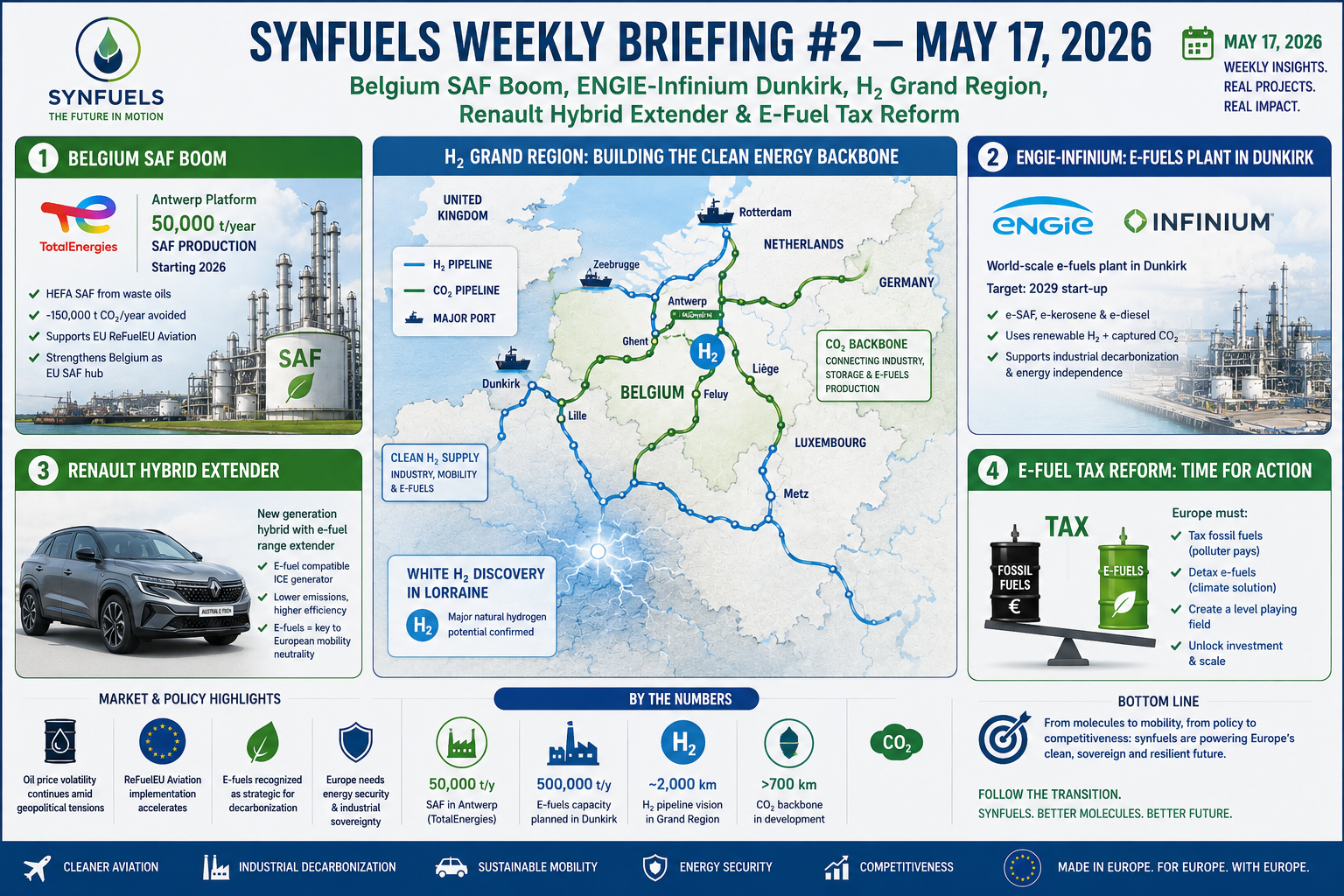
Welcome to Synfuels Weekly Briefing #2. This week: Belgium confirms two major SAF projects in one week. The hydrogen Grand Region pipeline gets closer to reality. Renault’s “range extender” hybrid reignites the e-fuels for road debate. And the call for a fuel tax reform — tax fossil more, tax e-fuels less — grows louder as the Iran context tightens European energy supply thinking.
LanzaTech Selects Ghent for Europe’s First Commercial ATJ SAF Plant — €500M · 79,000t/yr
On May 11, 2026, LanzaTech confirmed North Sea Port, Ghent as the site for the FLITE project — Europe’s first commercial-scale Alcohol-to-Jet SAF facility. The €500M plant will produce 79,000 tonnes of SAF per year using ethanol from the adjacent ArcelorMittal Steelanol plant. Environmental Impact Assessment scoping notification imminent. FID pending. Compliant with ReFuelEU, CORSIA and UK SAF Mandate.
TotalEnergies Antwerp: 50,000t/yr SAF via Coprocessing — Already Commissioning in 2025
TotalEnergies is simultaneously commissioning 50,000 tonnes per year of SAF at its Antwerp refinery via coprocessing — processing biomass alongside conventional hydrocarbons in existing refining units. Announced April 22, 2025, production was planned to start the same year. Antwerp joins TotalEnergies’ four-site French SAF network as the company’s first Belgian production site.
mosaHYc: The H₂ Pipeline Connecting Lorraine to Saarland — and Eventually Belgium
The mosaHYc hydrogen pipeline (90 km, €110M, FID April 2024) will connect the Lorraine region of France to Saarland, Germany — passing through one of Europe’s most hydrogen-rich geological areas. GRTgaz manages the French section (50 km); CREOS Deutschland the German section (40 km). Commissioning planned for 2027. Belgium’s Fluxys is simultaneously building hydrogen pipeline clusters at Antwerp with connections to the Netherlands and plans for German interconnection by 2028.
Renault’s “Range Extender” Hybrid — The New Argument for E-Fuels in Road Transport
The debate around electric vehicle weight — batteries of 400–800 kg add significant mass, creating road wear, bridge load and parking structure challenges — is strengthening interest in hybrid “range extender” architectures. Renault and Horse Powertrain (Renault/Geely/Aramco JV) are actively developing small, highly efficient combustion engines as range extenders. The Horse H12 Concept, tested at 3.3L/100km on 100% renewable Repsol Nexa 95 fuel, is the most advanced example.
Tax Fossil More, Tax E-Fuels Less — The Fiscal Lever Europe Is Not Using
E-fuels currently cost 3–8× more than fossil equivalents partly because they pay the same excise taxes. The EU Energy Taxation Directive revision (2024) opens the door to excise duty differentiation. Combined with the geopolitical context around Iran — which makes European fossil fuel import dependency a strategic vulnerability — the case for a fiscal shift has never been stronger politically. Detaxing certified e-fuels while raising fossil fuel excise would reduce the price premium without direct subsidies.
Source: EU Energy Taxation Directive 2024 · EASA reference prices · European Commission import dependency data — official- → Norsk e-Fuel Mosjøen: 50M litres eSAF update
- → INERATEC Normandie T.H2 JV: construction timeline
- → ReFuelEU 2025 compliance: first data from EASA
- → White hydrogen Lorraine: REGALOR II drilling results